
Description
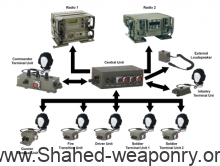
VIS-320/E armored Vehicular Intercommunication System is considered to establish voice communication as the main function of the system between the commander and crews of an armored vehicle/tank. In addition, by connecting this system to the two radios and Infantry Box (IB), external communication can be established for commander and the crews.VIS-320/E includes Central Unit (CU-320), Commander Terminal Unit (CTU-320), Crew Member Terminal Unit (CMTU-320), Gunner Terminal Unit (GTU-320), Infantry Terminal Unit (ITU-320), and External Loudspeaker (EL-320). Access of the crews and infantry to the radio 1 is gained by the commander via the Commander Terminal Unit. In this case, Crew Member/Infantry Terminal Units are under control of the Commander Terminal Unit completely. Access of the gunner to the radio 1 is gained via the Gunner/Commander Terminal Unit. Access of the crews to intercommunication is selected by available chest set of them. In all intercommunication and external communication, commander is in high priority and can gain its special access. Capabilities● Operable in various armored vehicles● Connecting to 6 crews and one infantry● Connecting to two radios● Connecting to the vehicle’s sensors and audio/visual alarms of the activated sensor● Connecting to external loudspeaker● Establishing internal communication as the intercommunication and holding conference between the crews● Capability of gaining access to the R1 for the crews due to the commander● Capability of gaining access to the R1 for the gunner in case that the commander is not present● Capability of disconnecting the driver from the R1● Controlling all of the communication statuses via the commander box● Easy operation● Displaying the communication statuses● Side tone capability while transmitting to the radio via the radio to make sure of its transmission● Programmable externally● Capability of turning ON/OFF the system via the Commander Terminal Unit● Capability of filtering the various noises created due to the vehicle● Proper quality of the voice for all statuses of the vehicle● Proper dimension for installing inside various vehicles● Easy troubleshooting General specifications System missionvoice transmission/receivingOperation typetactical military operationCommunication channelmulti-wire/pair wire cable (for infantry)Network capacity5 crews, 1 commander, and 1 infantryPhysical layers between the nodesanalog voiceDisplay typeLEDCrew/infantry connector type19-pin socket of the crew/commander andbinding post for infantryOperating voltage20~32VDC externallyConference typegeneral conferenceAlarm/display capability in thelaser/chemical attack, status of the gunner,Commander Terminal Unitdriver, and infantryOut of network communicationradio communication (R1 and R2) via the two VHF/LB radio setsMicrophone inputabout 1mV p-pCommand controlcontrolling communication between the crews and with the R1 and R2Connection alarm of the Infantryaudio alarm in commander helmet and LEDTerminal Unitindication on the Commander Terminal UnitAudio frequency response0.3-3.4KHzControlling the received audio levelby volume control as analog for each crew and the commanderInput/output ports2 radio inputs, 2 crew inputs, 1 commander input, 1 infantry input, in sensor input, and supply inputAudio outputone output for connecting external loudspeakerTactical capability and quickoksetting up Easy operationokSpecial specifications Capability of holding conferenceby the commanderand intercommunication Capability of radio transmission/by the commander and crewsreceiving in status of connecting to the radio 1 Capability of radio transmission/only by the commanderreceiving in status of connecting to the radio 2 Controlling and disconnectingby the commanderthe crew from the radio Side tone capabilityall of the crews individuallyCapability of differentiatingin transmitting and receiving status from thebetween the crew and radioradiocommunication Supplying the crewcentral supply (from the Central Unit)Supply of the Central Unitexternal supply (20-32 VDC from tank)Capability of turning ON/OFFvia a key in the Commander Terminal UnitEnvironmental and Mechanical SpecificationsOperating temperature-30°C ~ +65°C according to the MIL-STD-810 standardStorage temperature-40°C ~ +70°C according to the MIL-STD-810 standardHumidity95% according to the MIL-STD-810 standardEnvironmental testaccording to the MIL-STD-810 standardEMC/EMI testaccording to the MIL-STD-460 standard

Reviews
There are no reviews yet.